
Raging Against the Dying Light: A Systems View of Human Futures
Path Notes # 20

Do not go gentle into that good night.
Rage, rage against the dying of the light.
Dylan Thomas
I've just finished reading an advance copy of the Cascade Institute's Polycrisis Core Model Technical Synopsis.
It offers some mathematically sobering clarity for humanity.
They have identified and analyzed over 4 million potential planetary scenarios for the year 2040.
And 99.75% of the stable ones represent either the decline or collapse of our social and ecological systems.
I often write here about ecological consciousness — about mytho-poetics, animism, and aesthetics woven together with systems thinking. I sometimes think of it as complexity-compliant romanticism: a way of staying porous to beauty and aliveness even while facing the brutal realities of our time. To some, it might feel impossibly naïve in a world where malevolent actors wield such immense power. What good is being overwhelmed by the shimmering sentience of plants in the face of converging planetary crises?
More than we might realize.
In this post, I want to situate that sensibility within a practical theory of change and emergence. I’m going to summarize some important new research around potential planetary futures and muse a little on what I think it reveals about high value leverage points and our work at Wolf Willow.
There are no anecdotes in this one.
But there is an underlying story and I invite you to follow me down the polycrisis rabbit hole!
And just maybe we’ll find our way back out again.

What the Future Really Holds
The Polycrisis Core Model (PCM) Technical Synopsis summarizes the findings from a two-year research process that examined the relationships between multiple variables[i] and brought a complexity modeling lens to humanity's converging global crises - climate change, inequality, technological disruption, democratic breakdown, and economic instability.
There are over 4 million potential outcomes amongst the variables. But the model found only eleven mathematically stable planetary systems states likely to emerge by the year 2040[ii]. And these stable configurations cluster into three distinct futures.
And let’s not forget that by ‘future’ they mean 15 years from today.
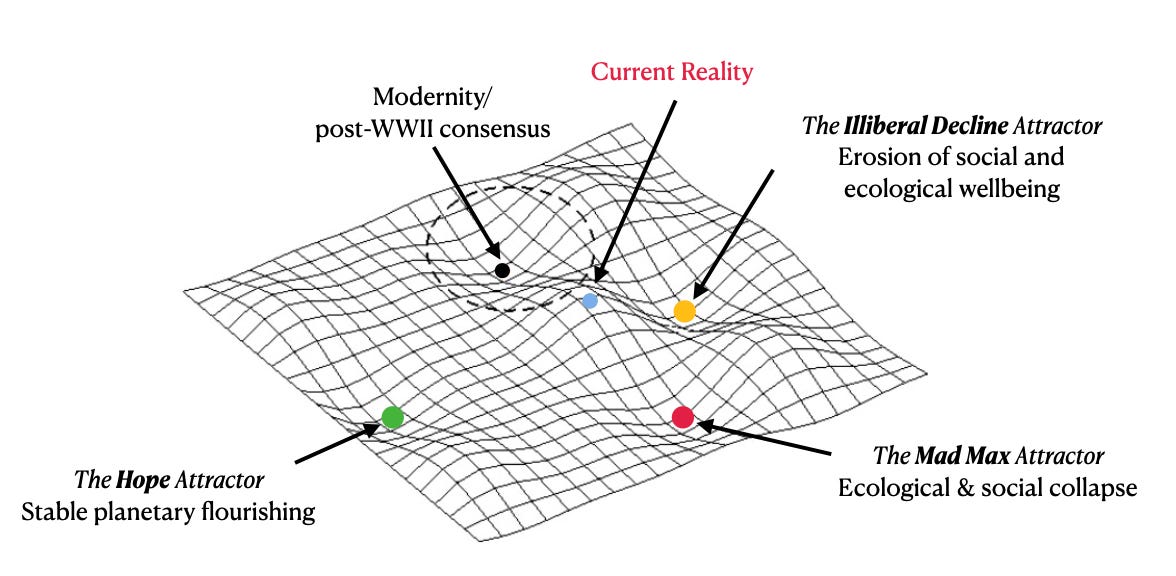
The massive Illiberal Decline attractor[iii] absorbs 75% of possible trajectories (over 3 million scenarios) and features illiberal democracy, international fragmentation, civil conflict, unmanaged technology rollout, low economic growth, medium disease burden, fossil fuel dependence, and high inequality.
The Mad Max collapse scenario draws in 12% of the scenarios (around 500,000) and represents thoroughgoing social, economic, and environmental breakdown with state failure, widespread violence, economic collapse, and deeply entrenched human misery.
The Hope attractor. It’s a small - 0.25% of possibilities (10,000 scenarios) – but mathematically stable configuration and features strong democracy, competent governance, guided economic growth, technological wisdom, environmental restoration, and dramatic reductions in inequality and violence.
Representing these as potential basins of attractions, gives you something like this:
But the diagram doesn’t represent the relative sizes[iv] and gravitational pull of each attractor which are more like this:
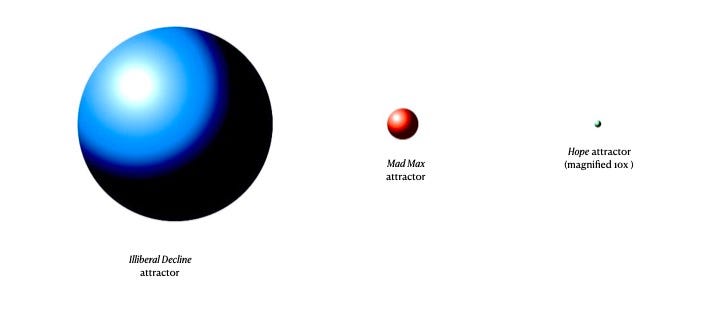
Just let that sink in for a minute or two.
What will you do with that information?
Looking at the PCM, three intervention logics emerge. You can:
Prepare for the collapse. Invest in resilience infrastructure and distributed networks - seed banks, local food systems, community self-reliance, alternative currencies, and the preservation of essential knowledge, culture and patterns of organization and human consciousness/development that could seed renewal. Focus on ensuring enough regenerative capacity that can survive the transition. It’s important work and probably necessary[v]. But the trouble with putting all your energy here is that collapse preparation can become self-fulfilling. And don’t forget that others – who have waaaaay more resources than you - are doing the exact same thing to ensure the survival of the very institutions and value systems you might believe are accelerating collapse in the first place!
Fight like hell to slow the decline. This is about mitigation strategies and rearguard actions - the reactive but essential work of defending democratic institutions through litigation, counter-narratives to authoritarianism, voting rights protection, and direct resistance to elite capture and information manipulation. It’s about protecting the civic infrastructure – journalism, civil society institutions, education systems etc. – needed for collective intelligence. It’s about slowing climate change. It’s about protecting biodiversity and living ecosystems. Above all, it’s about not sleepwalking into decline.
Or if I was going to be crude about it, don’t be so fucking compliant with your own demise!
Do not go gently into that good night.
Build hope. Do everything in your power to build collective capability and wisdom at scale. Build the institutions, technologies, mindsets, economic models, governance and learning systems – the patterns of consciousness and culture that can guide humanity toward flourishing.
In truth, we need all three: resilience, resistance, and renewal. They reinforce one another. No matter how profound your methodology for cultivating wisdom, there’s no excuse for not helping to resist the decline. And preparing for disaster – whether it’s forest fires or the threat of invasion[vi] – can be a critical and motivating entry point for building new levels of collective capability and cohesion.
What’s the PCM Good For?
The PCM is extremely coarse-grained – critics will likely make the case that it’s basically reductionism masquerading as comprehensiveness. There's no regional differentiation. It reduces the entire 'global system of systems' to just 11 variables with 3-5 states each, and it can’t capture the emergent movements, moments of grace and flashes of genius that often change history. And it doesn’t account for exponential complexity - 2nd and 3rd order effects – which would quickly take the modelling process into currently non-existent quantum computing terrain.
But it’s also a valuable and important contribution and here’s why:
It forces a crucial question - are you preparing for collapse, resisting decline, or building alternatives?
It cuts through the contextual noise to focus attention on underlying systems variables
It creates a common vocabulary for discussing what actually matters at civilizational scale
It condenses everything into a powerful and compelling visual that can generate some much-needed urgency
Above all, it highlights what is for me the most important question:
How do we actively navigate – at a species level - toward the Hope Attractor?

Why Governance Might Matter Most
I’m always looking for the one thing that impacts everything else.
And when I look at the PCM's eleven global system descriptors, polity type emerges as perhaps the most influential cross-cutting variable. The Hope attractor invariably features "strong democracy," while all decline scenarios show illiberal democracy, autocracy, or state failure.
Strong democratic governance is clearly a meta-capacity – it’s the institutional foundation that enables coordinated responses across all other domains. It’s what makes guided growth economics, managed rollout of technology, multilateral cooperation on climate, inequality reduction, and all the other things that characterize the Hope attractor possible. Without legitimate, adaptive governance, societies cannot navigate the complex trade-offs required for long-term flourishing.
But there are some critical paradoxes at play.
One is that centralized autocratic systems like China have a remarkable capacity to turn on a dime - implementing massive infrastructure projects, rapid technology adoption, and coordinated policy responses at unprecedented speed. Democratic systems, for all their adaptive advantages, often struggle with the very coordination the PCM suggests is essential for reaching the Hope attractor.
Another is the sheer vulnerability of democracy. Democratic institutions are particularly susceptible to elite capture, information manipulation, and what Gregory Bateson called schismogenesis - the escalating cycles of polarization that malevolent actors can exploit. Social media amplifies these dynamics, while concentrated wealth is distorting democratic processes. The unmanaged rollout of information technology that appears in most PCM decline scenarios often manifests as the weaponization of democratic openness against democracy itself.
But here's a third. Wise and effective democratic governance depends on something profound.
The consciousness of citizens.
Those depressingly rare beings that Bill Plotkin calls true adults.
The kind of strong democracy needed for transition to the Hope attractor is going to require a critical mass[vii]of mature, engaged citizens. And regardless of context or culture, those citizens are going to need some shared qualities:
They’re going to need the critical thinking, emotional regulation, empathy, resilience and sense of collective responsibility needed to navigate complexity and resist short-termism, manipulation and authoritarianism. The kinds of qualities described by the Inner Development Goals.
They’re going to need to embody the kind of republican virtues described as democratic essentials by America’s founders – honesty, civility, incorruptibility, active civic participation and putting the common good ahead of private gain.
They’re going to need an ethos of deep connectedness – to themselves, to each other and to the wider earth community.
And they’re going to need what we’ve called complexity consciousness from which flow: a long-term perspective that considers responsibility to future generations; a relational perspective that recognizes our fundamental interdependence and shared membership in the human family; an ecological perspective that understands the interconnectedness of all life; and a principled perspective grounded in self-restraint, right relationship, and deep commitment to collective flourishing.
Probably the most sophisticated integration of these things that I’ve encountered comes from the Haudenosaunee Confederacy and the Great Law of Peace. As I have learned it[viii], Haudenosaunee citizenship development is fundamentally relational, spiritual, ecological and inter-generational. It requires individuals to find and nurture their own unique gifts, to act with a sense of long-term, collective responsibility and to cultivate a good mind – a peaceful way of being that is aligned with natural law and the welfare of one’s people.
But whatever you call it, this kind of mature citizenship represents the critical ‘operating system upgrade’ humanity is going to need to participate in the kind of ‘strong democracy’ governance systems that can actually move us towards the Hope Attractor.
And for many of us, that’s going to require what transformative educator Edmund O’Sullivan calls "a deep, structural shift in the basic premises of thought, feelings, and actions...a shift of consciousness that dramatically and irreversibly alters our way of being in the world."
A fundamental shift from separation to relational embeddedness.
AKA worldview shift.
Worldview Shift?
Most so-called systems change initiatives fail because they don’t address worldview. Dismantle one system and it often respawns in another form, because the underlying patterns of thought and being remain intact.
Worldview is something more fundamental than our mental models, cognitive frameworks, paradigms, values and beliefs and meaning-making systems - even though we often use such terms inter-changeably.
Worldview is also an expression of how we belong to and are in relationship with the world.
Our mental frameworks don't exist in a vacuum - they emerge from and are constantly shaped by our embodied engagement with specific material realities. If you grew up in a hunting culture, you develop different cognitive patterns, temporal orientations, and social structures than your farming neighbours not just because of different "ideas" about the world, but because the daily rhythms of tracking animals versus tending crops literally rewire your neural pathways and shape collective meaning-making.
Different ecological conditions – mediated by our technologies - offer different affordances[ix]. We could think of these as eco-cultural niches that we have the potential to collectively inhabit and within which particular ways of being and knowing are more or less possible. It’s hard to develop certain forms of contemplative awareness while working three jobs to survive. You can't easily maintain hunter-forager reciprocity patterns within industrial capitalism. The material conditions of our lives constrain and enable particular forms of consciousness.
Worldview shift requires attention to both dimensions simultaneously. We can't just change our minds and expect systems to follow, nor can we only focus on changing external structures while ignoring the consciousness that creates and sustains them.
Worldview formation - and its transformation - unfolds through the living relationship between the inner and outer arcs of our experience.
It’s why our work at Wolf Willow focuses on the dynamic interplay between ecology, consciousness and culture.
And supporting the cultivation of mature worldviews.
Shift happens
Let me digress for a moment.
Worldview shift is clearly non-negotiable. But I’m wary of it.
I’m wary when people try to engineer it for others – even if their aim is noble. Whether its Maoist revolutionary thought reform, the Indian residential school movement or the use of LSD and conversion therapy to ‘cure’ homosexuality, history is full of coercive attempts to shift other people’s worldviews.
I’m also wary of how the isolated self understands worldview shift.
From a place of deep separation, a worldview shift can appear as something we must do to reality. The ego approaches transformation as another project: "I need to change my thinking so I can fix the world, solve problems, and secure my position." Change becomes violent and effortful…a kind of cognitive imperialism where one worldview must defeat and replace another even within ourselves.
But from a place of interconnectedness, a worldview shift is something that happens through us rather than by us It is developmental, relational and ecological. We don't have to storm the castle of our conditioning! We can simply stop feeding it our attention and watch it dissolve back into the living web that was always there beneath our mental constructions.
From an ecocentric perspective, worldviews arise from the kind of relationship we have with the whole, and they shift as we remember our participation in the larger dreaming. The ‘work’ is less about changing our minds and more about letting our minds be changed by the world we were never actually separate from in the first place! It’s about allowing the earth to think and dream through us, the future to feel through us, the mystery to know itself through our willing participation.
In this way, worldview shift becomes less reformation and more remembering. Not so much building new mental structures but dissolving back into the aliveness that predates all our stories about it.
Supporting this process has multiple dimensions and has been called many different names.
For the sake of simplicity, I’m going to call it transformative learning.
And I’m going to call the spaces and networks dedicated to it wisdom schools.
Our Theory of Influence
Whichever line of intervention you choose – preparing for collapse, fighting like hell or building hope – there’s plenty to be done. We don’t have to sit around and wait for the future to happen to us. There are multiple, high-leverage intervention points. Governance innovation. Building new wisdom schools. Mainstream educational system transformation. Supporting the emergence of post-capitalist economic forms. New media and narrative ecosystems.
But unless those things are led and crafted by people inhabiting mature worldviews, we’ll end up with some version of business as usual.
It sounds kind of elitist. But it’s true.
You don’t need me to tell you what happens when leaders, revolutionaries or tech moguls get handed massive power while still inhabiting adolescent, isolated or vindictive worldviews.
The Hope Attractor is already a longshot. But we're definitely not getting there unless we can cultivate both the leaders capable of designing regenerative systems and the citizens capable of inhabiting them! This isn't about finding perfect people - it's about developing enough humans who can think systemically, act ethically, belong ecologically and collaborate across difference when the stakes are planetary.
Our theory of influence at Wolf Willow centres on worldview shift.
Rather than trying to change systems directly, we work with people whose innovations and network influence can meaningfully shift the consciousness from which new systems emerge. Doing that has two dimensions:
One involves being a small living model of a wisdom school.
In practice this means working with small cohorts of particularly influential systems leaders who are uniquely positioned to catalyze and support the emergence of mature worldview patterns. Some are the innovators whose breakthrough work is poised for tangible impact at scale on critical challenges. Others are ecosystem builders who find, fund, connect, and amplify patterns of beneficial emergence across organizations, networks, and domains.
Reading the Polycrisis Core Model makes me think we should be focusing even more consciously on worldview. Doing a better job of both supporting leaders to fully inhabit a mature worldview and selecting participants for their capacity to influence worldview at scale.
The other involves catalyzing and supporting what we see as the emerging global wisdom school movement.
Applied research, partnerships, collaborations, and knowledge sharing that helps similar initiatives develop their own approaches to transformative learning. Rather than franchising our model, we’re working to contribute frameworks, practices, and insights that others can adapt to their cultural contexts and bioregional needs. Again the PCM invites me to think about this with greater focus and strategic intent.
Beyond Hope
I don’t see the Hope attractor as an endpoint. It’s the jumping off point for civilizational maturation.
It represents the stability and regenerative capacity needed to support humanity's deeper developmental potential…for the flowering of human capacities that remain largely dormant under conditions of scarcity, conflict, and environmental degradation.
From there we might ask new questions at scale: What does it mean to be truly human in relationship with the living cosmos? How might we participate consciously in the universe's unfolding? What forms of beauty, meaning and artistry are possible when survival is no longer at stake?
We stand, as Thomas Berry wrote, in a moment of grace - a rare chance to evolve our consciousness in service of life itself. The window is open, but not indefinitely. To rage against the dying light now is to cultivate the wisdom, resilience, and creativity needed for planetary flourishing.
It won’t be easy.
It may not even be possible.
But it will be beautiful.
And the question remains…
Which attractor will you give your life to?
In solidarity
Julian
[i] The variables are: polity type, world order, conflict and security, information technology, economy, health, food systems, energy, transportation, climate, and inequality. Each of these has three to five different potential states. For example, polity identifies five broad political states; strong democracy, illiberal democracy, weak autocracy, strong autocracy and nonocracy.
[ii] Interestingly, that’s the same year chosen by the US National Intelligence Council’s 2021 scenario planning document Global Trends 2040 which I just reread and highly recommend. While Cascade’s model identifies stable and self-reinforcing basins of attraction that have the potential to ‘pull’ the global system into their orbit, the NIC document identifies structural drivers that ‘push’ systems into plausible scenarios at social, state and global levels. I highly recommend looking at the two side by side.
[iii] By way of reminder, an attractor is the particular state, long-term behaviour, mathematical value set or organizing pattern to which a dynamic system tends towards over time. It’s where a system settles. When we talk about attractors, we are reminding ourselves that the behaviour of a system is not just driven by its prior behaviour but is ‘pulled’ or headed towards some probable pattern.
[iv] I had to magnify the Hope Attractor here by a factor of 10 just to be able to see it on the page!
[v] For what it’s worth, I think it is worth putting energy here – but probably not in the way most preppers and eco-catastrophists think. If you are thinking at a planetary scale, then you likely need to work at a national level. It’s probably better to invest in countries like Finland, New Zealand or Norway that already have strong democracies, high social cohesion, self-reliant populations, relatively high ecological consciousness and bio-regional awareness, broadly favourable geopolitical locations and robust defence systems than a few lightly armed eco-villages in less stable or geographically fortunate countries.
[vi] It’s a conversation for another time, but the policy ideas emerging in Canada around a renewed form of National Service to build social cohesion and defence capability in the face of a rapidly changing threat landscape offers an interesting opening. National service might be a more likely way for countries to invest in human development than emulating the very successful – but expensive – Scandinavian Folk School movement that was arguably the transformative learning engine that resulted in the success of Nordic countries. How do we leverage the opportunity this might present?
[vii] What constitutes a critical mass here? My hunch is somewhere around 35 – 40%
[viii] I gratefully acknowledge Marlyn Kane (from Kahnawake), Carol Squires and Ian Sanderson (both from Six Nations) who have been kind enough to share parts of these teachings with me in person over the years.
[ix] I want to recognize the brilliant anthropologist Tim Ingold who originally introduced me to this concept when I was his tutorial student in the 80’s.
Totally agree. Personally, I have focused more on thinking about the dominant scientific worldview and its limitations. Relational thinking—fusing disciplines so we acknowledge, for example, non human animal cultures rather than just behaviors & instincts, makes animal welfare science so much more exciting. The possibility of embracing complexity at a global level is a breath of fresh air. We must take more responsibility in seeding pockets of hope. I remember listening to an online discussion involving Alicia Juarrero, a leader in complexity and top-down systems, who described a difference between machines and us. If I remember correctly, she said "We don't break - we fail gracefully". We are resilient. As a biologist, I also think we can learn from our own bodies. Immunity was always described as a battle against the foreign body (be it a pathogen or something else) until we realized that we need only react to the "foreign" agent that damages us. Otherwise our immune system could leave well alone and valuable energy could be spent elsewhere. There's a lesson for us all!
This is brilliant. Thank you, Julian!